

A Fun New Way Kids Learn English Sentences : The Archer Game
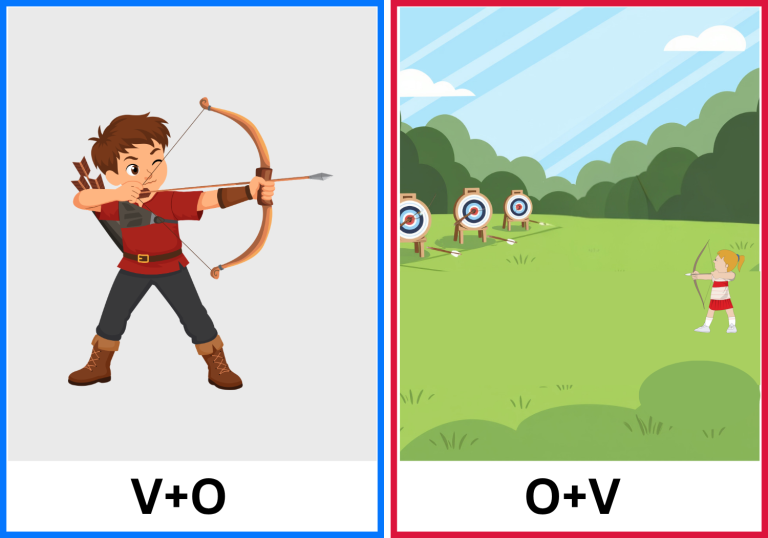
“English is too hard. The word order is backwards from Korean.”
If you teach ESL or homeschool young kids, you’ve heard this one.
Most of us answer with a rule: “Verb after the subject, then the object — just flip the Korean around.” That’s usually when the child checks out. English stops being a language and becomes a translation puzzle.
So let’s drop the grammar labels and give kids a picture instead. Once they see the picture, the word order follows — and it turns into a game, not homework.
👐 The lens your child already has
Korean is an object-verb (OV) language. Speaking it is like setting a stage before the actors walk on — a wide-angle lens.
You start with the widest frame, time and place: “Yesterday, on the playground…” Then the people and objects. The verb lands last, like a curtain dropping.
🏹 The English lens: follow the arrow
English (verb-object, VO) is the reverse — a telephoto lens, one thing sharp, everything else blurry. Words come out in the order an arrow travels.
Tell your child to be the archer:
- The archer appears → subject. Someone holds the bow. (I)
- The release → verb. The action follows the person doing it. (kicked)
- The hit → object. Whatever the arrow lands on. (the ball)
- Past the target → context. The arrow flies on — nearest detail first, widest last. (in the yard → yesterday)
The flight path: I → kicked → the ball → in the yard → yesterday
🎯 Try it as a game
This works best off the page. A few ways to make it physical:
- Act it out. Have your child mime pulling back a bow and “shooting” each word as they say it: I (aim) — kicked (release!) — the ball (hit!).
- Use real objects. Line up toys on the floor in sentence order. Move a toy figure forward one word at a time as your child builds the sentence: “I” → “ate” → “an apple.”
- Draw the arrow. Let your child draw a simple arrow on paper and write one word along it at a time, left to right.
- Keep sentences tiny at first. I ate. I ate rice. I ate rice at home. Add one piece at a time so the arrow keeps flying instead of stalling.
🧩 Why this changes everything else
| 🏹 English | 👐 Korean | |
|---|---|---|
| Location markers | Before the noun — in the room | After the noun — 방에서 |
| Long descriptions | After the noun — the boy who lives next door | Before it — 옆집에 사는 소년 |
English says the point first and lets details follow. Korean gathers details first, then lands the point.
✨ What to do instead
Skip “translate it backwards.” It’s true, but it gives a child nothing to do.
Instead, hand them the game: “You’re the archer. Ready… aim… who’s the archer? Now shoot the action! What did it hit? Where were you? When?”
When the grammar words disappear and a game takes their place, so does most of the fear. What’s left sounds like: “Oh — it’s just building blocks.”
Tonight, fire off one English arrow with your child. 😊